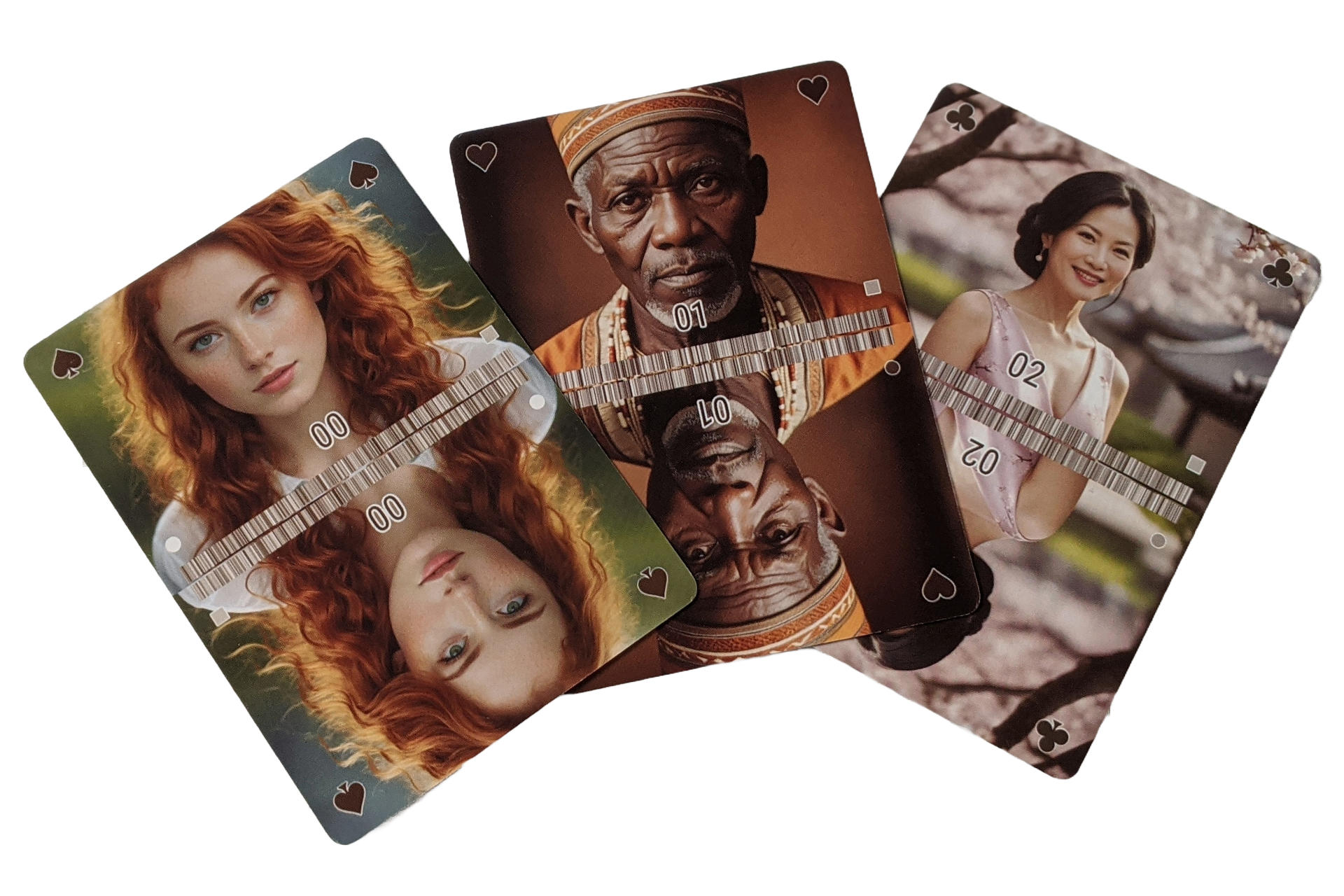
Product Image

FACER

CARD GAME

Read faces like a pro with FACER, a card game that turns facial recognition into a fun challenge. With its simple yet strategic gameplay, FACER is perfect for game nights, family gatherings, or anyone looking to challenge their perception.

Learn More

What if you could read faces like a poker hand? Welcome to FACER, the card game that blends fun, strategy, and a touch of data science into a truly unique experience.

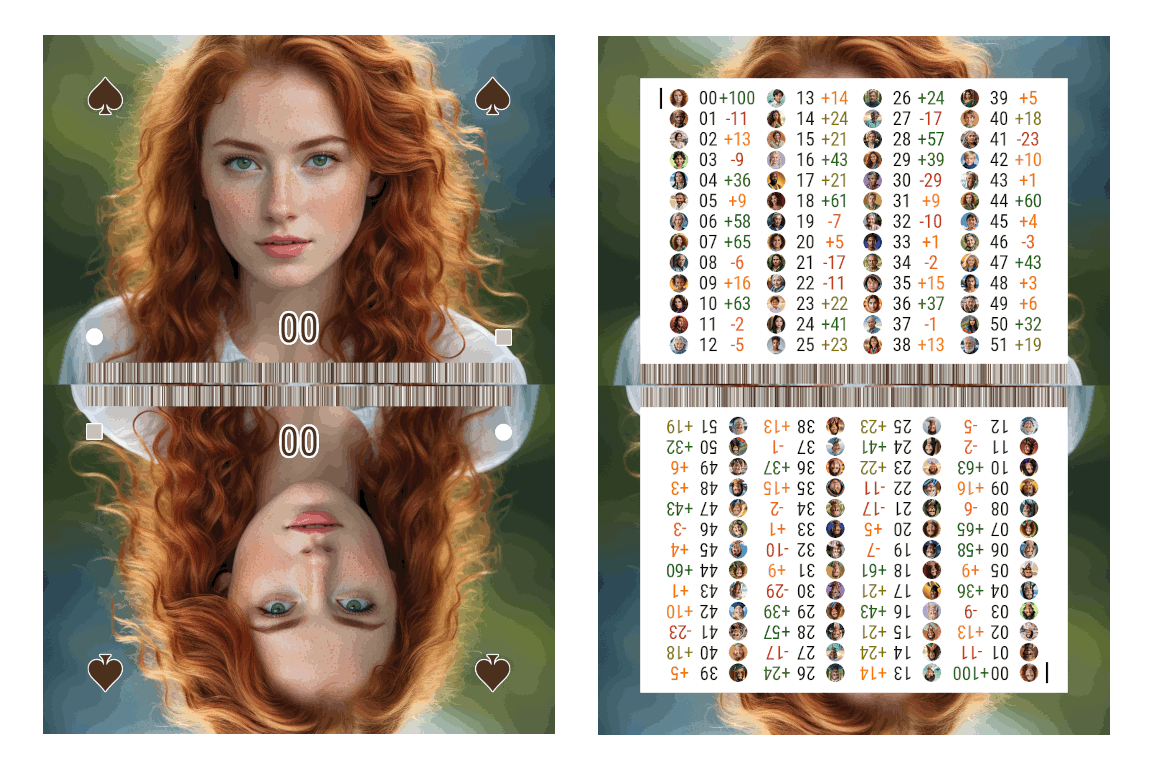
In FACER, every card has a face—literally. Each card in the deck showcases a unique face on the front, while the back of the card reveals the similarity scores between that face and others in the deck, as determined by a cutting-edge machine learning algorithm. But don’t worry, you don’t need a degree in data science to play—just a keen eye for detail and a knack for comparison.

Example of the front and back of a FACER card

The Gameplay

FACER is designed to be as versatile as it is intriguing. Whether you’re in the mood for a competitive round of face-based poker or a cooperative challenge where teamwork reigns supreme, this game has you covered.

Competitive Mode: Players compete to build the strongest “hand” based on the similarity of the faces they hold. Think poker, but with faces. The more similar the faces, the stronger the hand. It’s a test of your perception, strategy, and maybe just a little bit of bluffing.

Cooperative Mode: Alternatively, players can join forces to find pairs of faces that share varying degrees of similarity. The goal? Work together to create more and more similar pairs and win the game as a team. It’s a subtle exercise in communication, teamwork, and a shared sense of observation.

Why FACER?

  • Quick to Learn, Fun to Master: FACER is incredibly easy to pick up, with straightforward rules that allow you to jump right in. But don’t be fooled by its simplicity—mastering the art of face comparison offers endless strategic depth.
  • Engaging and Educational: FACER isn’t just entertaining; it also introduces players to basic concepts of data science and machine learning in a way that’s natural and intuitive. You’ll find yourself thinking about the patterns and features that make each face unique, all while enjoying a lively game with friends or family.
  • Endless Replayability: With so many possible face combinations, no two games of FACER are ever the same. Every round offers a new challenge and new strategies to explore.

Learn How to Play

FACER
FACER

Measure the similarity of faces.

FACER
JOKER FACER

Match faces with text captions.

How to play

Several games can be played with the cards. Below are some suggested games, but feel free to modify them or make up your own.

FACER

Cooper

A cooperative game in which you have to form better and better pairs of faces. No mistakes are allowed.

OBJECTIVE

GOAL To make increasingly similar pairs of cards, collaborating with fellow players.

GAME SETUP

PLAYERS Each player starts with 4 cards facing up in front of them.

CENTER A number of cards equal to the number of players is placed in the center of the table.

GAMEPLAY

PAIRING Each player pairs one of their cards with a center card each round. There's no set turn order, players can act freely, with or without consensus. The first player to act must try to create a relatively dissimilar pair, while the players who follow must always create more and more similar pairs.

NEW ROUND If all pairs are correctly formed (that is, each newly formed pair is a better match than the ones formed earlier in this round), the game moves to the next round with new cards added to the center. Players are not dealt new cards, they must choose from their remaining cards for the next round.

FINISH

LOSING If a pair is formed that's less similar than a previously formed pair in the same round, everyone loses.

WINNING The game ends in victory if all players’ cards are paired correctly without any mistakes.

Recommended
Poker

Play poker with faces! The winner is the one who holds the most similar faces. (Or who bets cleverly.)

OBJECTIVE

GOAL To win the pot. (Hold similar cards in proper order to maximize neighbor similarity, and bet wisely.)

GAME SETUP

CHIPS Get something to bet with.
Poker chips, sunflower seeds, peanuts, candies, bottle caps, money, whatever.

FORCED BETS Decide whether to play with ante or blinds and determine the amount.
For example, each player must ante up 1 poker chip to get dealt cards.

CARDS Deal 5 cards to each player, face up (literally). Each player places their cards in front of them in a row.
All cards dealt are visible to all players.

GAMEPLAY

FIRST BETTING ROUND Do betting in a clockwise order, starting with the player to the left of the dealer (or to the left of the blinds, if you play with blinds). Each player can check (that is, bet 0) or bet (some positive amount), then call (match the bet), raise (match the bet and increase it) or fold (give up), until everyone calls or folds after a raise or bet.

DRAW The remaining players can discard some cards and they get from the deck the same number of cards they discarded.
Reshuffle the discarded cards if the deck runs out.

SECOND BETTING ROUND A betting round, identical to the previous one, follows.

RANKING The remaining players can change the order of their cards as they wish.

FINISH

SUMDOWN Each remaining player turns over their cards, finds the similarities between their adjacent cards, and adds up the 4 values---the sum becomes their score. The player with the highest score wins.
Don't worry! Sometimes a rough estimate is enough to determine the winner. (First just add up the tens…)

ALTERNATIVE GAMES

TRADER The same as Poker, but after the first betting round, players can not only discard and draw cards from the deck, but also exchange with each other (one card for one card). Players can also pay their fellow players to engage in the trade.

HIDDEN CARDS We recommend playing poker with your cards face up; however, you may also choose to play with concealed cards (stack your cards in a way that only the top card's face is visible).

TEXAS HOLD 'EM Deal 2 cards to each player, bet, deal 3 community cards ('flop'), bet, a fourth community card ('turn'), bet, a fifth community card ('river'), bet. Scoring is done sequentially: each player can choose which 5 cards to use and in which order.

Matcher

Choose the face that best matches the target card.

OBJECTIVE

GOAL To collect the most chips by accurately matching and guessing cards.

GAME SETUP

Each player receives 1 chip (to be used as a marker) and 5 cards (to be placed in front of them, face up). The deck is placed in the center of the table, face up.

GAMEPLAY

CARD SELECTION Each player selects the card from their hand that they think most closely resembles the card on top of the deck. The chosen cards are placed next to the deck.

CHIP PLACEMENT Each player places a chip on the card (among the nominees) that they believe is actually most similar to the one on top of the deck.

SCORING

BEST MATCH: 3 chips are awarded to the player whose card is the closest match to the top card of the deck.

CORRECT GUESS: 2 chips go to the player who correctly guessed which card was the best match.

MOST GUESSED: 1 chip is awarded to the player whose card was most frequently guessed to be the best match.

After the chips are distributed, the card on top of the deck is moved to the bottom, a card is dealt to each player, and a new round begins.

FINISH

The game continues until the chips (or the willingness to play) run out. The winner is the player who collects the most chips.

JOKER FACER

Cooper

A cooperative game in which you have to form better and better face-caption pairs. No mistakes are allowed.

OBJECTIVE

GOAL To form increasingly matching face-caption pairs, collaborating with fellow players.

GAME SETUP

PLAYERS Each player starts with 4 face cards facing up in front of them.

CENTER A number of text cards equal to the number of players is placed in the center of the table.

GAMEPLAY

PAIRING Each player pairs one of their image cards with a text card each round. There's no set turn order, players can act freely, with or without consensus. The first player to act must try to create a relatively poorly matching pair, while the players who follow must always create better and better pairs.

NEW ROUND If all pairs are correctly formed (that is, each newly formed pair is a better match than the ones formed earlier in this round), the game moves to the next round with new cards added to the center. Players are not dealt new cards, they must choose from their remaining cards for the next round.

FINISH

LOSING If a pair is formed that is a worse match than a previously formed pair in the same round, everyone loses.

WINNING The game ends in victory if all players’ cards are paired correctly without any mistakes.

ALTERNATIVE GAME

The game can be played in reverse, with players receiving captions and matching them with faces placed in the center.

Recommended
Poker

Play poker with faces and captions! The winner is the one who holds the best face-caption pairs. (Or who bets cleverly.)

OBJECTIVE

GOAL To win the pot. (Hold similar pairs of cards, and bet wisely.)

GAME SETUP

CHIPS Get something to bet with.
Poker chips, sunflower seeds, peanuts, candies, bottle caps, money, whatever.

FORCED BETS Decide whether to play with ante or blinds and determine the amount.
For example, each player must ante up 1 poker chip to get dealt cards.

CARDS Deal 4 face cards and 4 caption cards to each player, face up. Each player places their cards in two rows in front of them.
All cards dealt are visible to all players.

GAMEPLAY

FIRST BETTING ROUND Do betting in a clockwise order, starting with the player to the left of the dealer (or to the left of the blinds, if you play with blinds). Each player can check (that is, bet 0) or bet (some positive amount), then call (match the bet), raise (match the bet and increase it) or fold (give up), until everyone calls or folds after a raise or bet.

DRAW The remaining players can discard some cards and they get from the decks the same number (and same type) of cards they discarded.
Reshuffle the discarded cards if a deck runs out.

SECOND BETTING ROUND A betting round, identical to the previous one, follows.

PAIRING The remaining players form face-caption pairs from their cards.

FINISH

SUMDOWN Each remaining player turns over their cards, finds the similarities between their face-caption pairs, and adds up the 4 values—the sum becomes their score. The player with the highest score wins.
Don't worry! Calculator is your friend.

ALTERNATIVE GAMES

TRADER Trader: the same as Poker, but after the first betting round, players can not only discard and draw cards from the deck, but also exchange with each other (one card for one card). Players can also pay their fellow players to engage in the trade.

HIDDEN CARDS We recommend playing poker with your cards face up; however, you may also choose to play with concealed cards (stack your cards in a way that only the top card's face is visible).

Matcher

Choose the face that best matches the target caption.

OBJECTIVE

GOAL To collect the most chips by accurately matching and guessing cards.

GAME SETUP

Each player receives 1 chip (to be used as a marker) and 5 image cards (to be placed in front of them, face up). The deck of text cards is placed in the center of the table with the text facing up.

GAMEPLAY

CARD SELECTION Each player selects the card from their hand that they think best matches the top card of the text deck. The chosen cards are placed next to the deck.

CHIP PLACEMENT Each player places a chip on the card (among the nominees) that they believe is actually the best face for the caption on top of the text deck.

SCORING

BEST MATCH: 3 chips are awarded to the player whose card is the closest match to the top card of the text deck.

CORRECT GUESS: 2 chips go to the player who correctly guessed which card was the best match.

MOST GUESSED: 1 chip is awarded to the player whose card was most frequently guessed to be the best match.

After the chips are distributed, the card on top of the text deck is moved to the bottom, an image card is dealt to each player, and a new round begins.

FINISH

The game continues until the chips (or the willingness to play) run out. The winner is the player who collects the most chips.

ALTERNATIVE GAME

The game can be played in reverse, with players receiving captions and matching them with the face on top of the image deck.

Cheat sheet

Analyzing faces might be difficult, but machine learning is here to help. The barcode-like horizontal plots below the faces show the embeddings generated by FaceNet. All values of the 512-dimensional embeddings are min-max normalized to the range of [0, 1] so that the card with the lowest value gets 0 and the card with the highest value gets 1. The scaled values are represented by a linear colormap, where white corresponds to the lowest value and a representative low-luminance color of the image (selected by k-means clustering) denotes the highest value. The shapes (●, ■) represent the first 2 principal components of the embeddings. Faces are grouped into 4 clusters (♠, ♥, ♣, ♦) using agglomerative clustering with cosine distance and average linkage based on the FaceNet embeddings. The values on the backs of the cards are the cosine similarities between the 2 corresponding face embeddings multiplied by 100 and rounded to the nearest integer. The optimal arrangement of your poker hand is actually a solution to an open traveling salesperson problem in a 512-dimensional space. By the way, do the people on the cards exist, or were they just created by generative artificial intelligence?

DEFINITIONS

for adults

MACHINE LEARNING

Machine learning is a subset of artificial intelligence that involves the use of statistical algorithms to enable computers to learn from and make predictions or decisions based on data.

EMBEDDING

An embedding is a relatively low-dimensional, dense representation of high-dimensional data, such as words or images, capturing semantic relationships in a vector space.

FACENET

FaceNet uses deep convolutional neural networks to embed faces into a high-dimensional space, where the distance between these embeddings directly corresponds to face similarity.

CLUSTERING

Clustering is the process of dividing a set of data points into groups, such that points in the same group are more similar to each other than to those in other groups, based on predefined criteria.

PRINCIPAL COMPONENT ANALYSIS

PCA reduces the dimensionality of a dataset by transforming it into a new set of variables that are linear combinations of the original variables, ordered by the amount of variance they capture.

COSINE SIMILARITY

Cosine similarity measures the cosine of the angle between two non-zero vectors in a multidimensional space, indicating how similar they are regardless of their magnitude.

TRAVELING SALESMAN PROBLEM

TSP is an optimization problem that seeks to find the shortest possible route that visits a set of locations once and returns to the starting point. (Open TSP: no return required.)

GENERATIVE ARTIFICIAL INTELLIGENCE

Generative AI refers to the subset of AI technologies that can generate new content, such as text, images, or music, that is similar to but not identical to data it has been trained on.

DEFINITIONS

for 5-year-olds

MACHINE LEARNING

Machine learning is like teaching a computer to solve puzzles by showing it lots of examples, so it gets better and smarter all by itself!

EMBEDDING

Embedding in machine learning is like turning things like words or pictures into a special kind of map, where similar things are placed close together.

FACENET

FaceNet is like a smart computer program that can look at pictures of faces and remember who each person is, just like how you recognize your friends and family by looking at them.

CLUSTERING

Clustering is like sorting your toys into groups where each group has toys that are kind of alike.

PRINCIPAL COMPONENT ANALYSIS

PCA is like finding the most important features of a story to tell it simply and clearly, using just a few key details.

COSINE SIMILARITY

Cosine similarity is like checking if two friends have the same favorite toys, not caring how many toys they each have.

TRAVELING SALESMAN PROBLEM

The Traveling Salesman Problem (TPS) is like trying to find the shortest way to visit lots of places on a map and come back home. (Open TSP: you don't have to come back home.)

GENERATIVE ARTIFICIAL INTELLIGENCE

Generative AI is like a smart robot that can make up its own stories, draw pictures, or create music just like we do, but it learns how to do it by looking at lots of examples first.

Judging faces might be difficult, but machine learning is here to help. The barcode-like horizontal plots below the faces show the embeddings generated by CLIP. All values of the 512-dimensional embeddings are min-max normalized to the range of [0, 1] so that the card with the lowest value gets 0 and the card with the highest value gets 1. The scaled values are represented by a linear colormap, where white corresponds to the lowest value and a representative low-luminance color of the image (selected by k-means clustering) denotes the highest value. The shapes (●, ■) represent the first 2 principal components of the embeddings. The values on the backs of the cards are the cosine similarities between the 2 corresponding embeddings multiplied by 100 and rounded to the nearest integer. The optimal pairing of your poker hand is actually a solution to an assignment problem, or maximum weight perfect matching in a complete bipartite graph. By the way, do the people on the cards exist, or were they just created by generative artificial intelligence?

DEFINITIONS

for adults

MACHINE LEARNING

Machine learning is a subset of artificial intelligence that involves the use of statistical algorithms to enable computers to learn from and make predictions or decisions based on data.

EMBEDDING

An embedding is a relatively low-dimensional, dense representation of high-dimensional data, such as words or images, capturing semantic relationships in a vector space.

CLIP

CLIP (Contrastive Language–Image Pre-training) is a neural network that learns visual concepts from natural language descriptions, enabling it to understand associations between text and images.

CLUSTERING

Clustering is the process of dividing a set of data points into groups, such that points in the same group are more similar to each other than to those in other groups, based on predefined criteria.

PRINCIPAL COMPONENT ANALYSIS

PCA reduces the dimensionality of a dataset by transforming it into a new set of variables that are linear combinations of the original variables, ordered by the amount of variance they capture.

COSINE SIMILARITY

Cosine similarity measures the cosine of the angle between two non-zero vectors in a multidimensional space, indicating how similar they are regardless of their magnitude.

MAXIMUM WEIGHT PERFECT MATCHING

A maximum weight perfect matching in a graph is a set of edges with the highest possible total weight, where each vertex is incident to exactly one edge, forming a perfect matching.

GENERATIVE ARTIFICIAL INTELLIGENCE

Generative AI refers to the subset of AI technologies that can generate new content, such as text, images, or music, that is similar to but not identical to data it has been trained on.

DEFINITIONS

for 5-year-olds

MACHINE LEARNING

Machine learning is like teaching a computer to solve puzzles by showing it lots of examples, so it gets better and smarter all by itself!

EMBEDDING

Embedding in machine learning is like turning things like words or pictures into a special kind of map, where similar things are placed close together.

CLIP

CLIP is like a smart robot that can look at pictures and words at the same time to understand what they both mean and how they match together.

CLUSTERING

Clustering is like sorting your toys into groups where each group has toys that are kind of alike.

PRINCIPAL COMPONENT ANALYSIS

PCA is like finding the most important features of a story to tell it simply and clearly, using just a few key details.

COSINE SIMILARITY

Cosine similarity is like checking if two friends have the same favorite toys, not caring how many toys they each have.

MAXIMUM WEIGHT PERFECT MATCHING

It's like finding the best pairs of friends in a group so that when they hold hands, the total happiness is the biggest.

GENERATIVE ARTIFICIAL INTELLIGENCE

Generative AI is like a smart robot that can make up its own stories, draw pictures, or create music just like we do, but it learns how to do it by looking at lots of examples first.

Let's Play

FACER
Base Pack

Buy FACER
FACER
Custom Pack

To the app
FACER
Base Pack

Buy FACER
FACER
Custom Pack

To the app

Get in Touch

Interested in learning more about our card game or have any questions? Reach out to us at: